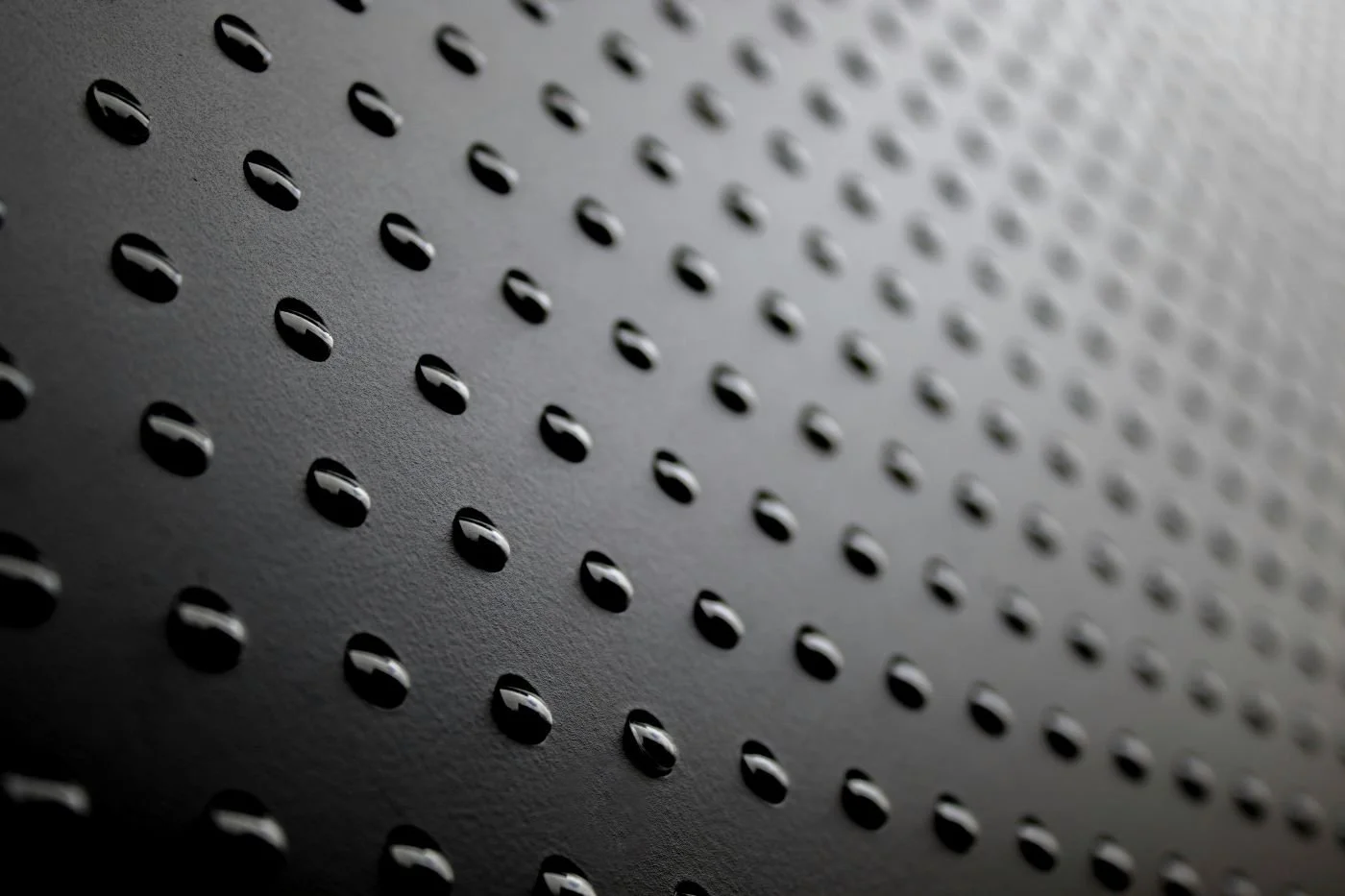
AMVI Cuff Materials — Sterling Silver, Black Rhodium, Green Sapphire, Satin Finish — Atelier CPII
Every material in the AMVI Cuff was chosen for structural and visual logic, not convention. Sterling silver for its working properties. Black rhodium for its depth and restraint. Green sapphire for its geometric relationship to the grille. Satin surfaces because they read as machined, not decorated.
Sterling Silver
Black Rhodium
Green Sapphire
Satin Surface
Silver
Rhodium
Sapphire
Surface

Sterling
Silver
Sterling silver is the structural foundation of the AMVI Cuff. At 92.5% pure silver, it is the most workable precious metal at this weight class — responsive to the precise forming required to achieve the cuff's convex band profile and grille architecture without compromise.
The choice of silver over gold is a material logic decision. Silver takes a satin finish and black rhodium more uniformly than gold. Its cooler tone reads closer to machined steel. The object is designed to look like it came from an industrial process, not a jeweller's bench.
Black
Rhodium
Rhodium is a platinum-group metal, rarer than gold and the standard finish on the finest white gold work. In its black form it produces the deepest non-reflective dark available on precious metal. It is not paint and not lacquer. It is metal on metal.
On the AMVI Cuff it is applied over a satin-prepared surface, so the texture of the silver carries through the finish. The recesses of the grille are darkened so the bars read in relief. Depth is built into the surface, not printed onto it.


Green
Sapphire
After diamond, nothing in jewellery is harder. That hardness is not incidental — it means the stone holds its edge, its polish, and its colour over decades of contact wear without degradation.
The green is not a treatment or a coating. It is a property of the crystal itself, produced by trace elements present during formation. Depending on the light, it reads closer to the brand's architectural teal than to any conventional jewel tone. It was set at the centre of the grille because the geometry required a terminus. The stone is that terminus.
Satin
Surface
The cuff carries three surface depths. The grille bars are satin-finished with a directional grain. The recesses between them are darkened so the bars stand in relief. The band is satin at a finer grain, a quiet field the grille sits on.
This is the surface logic of fine watchmaking. Nothing flashes. Under a desk lamp or in direct sun, the object reads the same. The form is always visible. The surface never competes with it.